Settlement
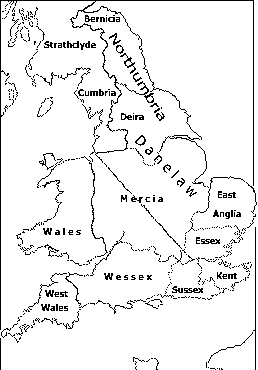
We know very little of the first few hundred years of the Anglo-Saxon, or "English", era, primarily because the invaders were an illiterate people. Our earliest records of them are little more than highly inventive lists of rulers. We know that they established separate kingdoms, the Saxons settling in the south and west, the Angles in the east and north, and the Jutes on the Isle of Wight and the mainland opposite. They probably thought of themselves as separate peoples, but they shared a common language and similar customs.
The king's power
One of these customs was fighting everyone in sight. A king's power was not hereditary; it depended solely on his ability to win battles and so gain land, treasure, and slaves to give his supporters. He was obliged to fight and keep fighting. If not, he would find himself out of a job or deprived of his life, or both.
Succession from father to son was never a foregone conclusion. Any relative of the old king who could muster enough support could make a bid for the throne. This helps to explain why the Anglo-Saxon kingdoms came and went so quickly. The power of any kingdom over its neighbours was only as solid as the strength of its king in battle.
King Offa
Roughly speaking, the 7th century was the age of Northumbrian ascendance, with Mercia playing second fiddle. In the 8th century, these roles reversed. The most powerful and well known of the Mercian kings was Offa, who ruled from 758-796. A successful warrior (which is a given for anyone in those days who managed to hold onto power for so long), he defeated kings in Sussex, Anglia, and Wessex, proclaiming himself King of the English.

Offa's DykeOffa caused to be built the earthwork that still bears his name, Offa's Dyke, which stretches the 150-mile length of the Welsh border. Begun in the 780s, the purpose of the dyke seems to have been as a fortified frontier barrier, much as Hadrian's Wall some six centuries previous.
In most places the ditch was 25 feet from the bottom of the cut to the top of the bank, with wood or stone walling on top of that. The work involved has been compared to the building of the Great Pyramid. This gives us some idea of the power wielded by Offa. It seems that the dyke was not permanently manned, the Mercians relying instead on the warning given by a series of beacons.
Foreign attack
The upper hand enjoyed by the Mercians did not long survive Offa's death. In the 820s a series of victories by Egbert, king of Wessex, broke Mercian control in the south-east. The 9th century may well have turned into a struggle for the upper hand between Mercia and Wessex if not for one thing; England was once again the subject of recurring raids from across the seas. This time it was the Danes and Norwegians. The Danes attacked the east coast of England, the Norwegians attacked the north by way of Ireland and Scotland.
The Danes
The Danes found rich pickings in the undefended monastic settlements on Lindisfarne Island and Jarrow, in Northumbria, but they were not out solely for loot. The Danish raids were partly a response to population pressures in their homeland, so they wanted new lands to settle, not merely easy plunder. They made good use of fortified settlements as bases to expand, and their use of helmets, shields, chain mail, and particularly the long-handled battle-axe, meant they were better armed than most of their foes.
Related:
Alfred the Great
Anglo-Saxon attractions in Britain
Also see "Anglo-Saxon London" in our "London History" section.