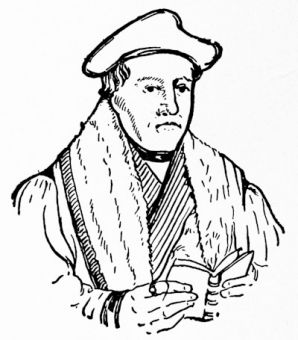
The Book of Common Prayer represents an attempt by Thomas Cranmer to introduce church reform in England. Cranmer had risen to prominence by suggesting means to implement Henry VIII's much-desired divorce from Catherine of Aragorn. A grateful Henry made Cranmer his aide in carrying out the divorce and in 1533 made Cranmer Archbishop of Canterbury. Though Cranmer did not participate in some of Henry's more zealous anticlerical acts, he held very profound beliefs about the direction the church should take.
Though Cranmer was hampered during Henry's lifetime from carrying out many of his own reforms, the old king's death in 1547 put the archbishop in a position to carry out a program of religious reform. In 1549 he put forward his major work, The Book of Common Prayer.
This handbook for liturgical practice combined in one volume Cranmer's own versions of the Catholic Breviary, Missal, Pontifical, and Ritual. In the Book and the revised version that followed in 1552 Cranmer laid down the language and practice that should guide the Anglican church in England. Adherence to the practices outlined in the Book of Common Prayer was made compulsory under law in the Act of Uniformity of 1549.
One of the most controversial aspects of the Book of Common Prayer was its promotion of the belief that the success of Communion depended more upon the receptive heart of the Christian participant than the actual bread and wine used. This and other aspects of the Book put it at the centre of a storm of controversy. Many churchmen refused to use the new books or follow the observances.
The revised version of the Book of Common Prayer was published in 1552 and was still more radical in its departure from Catholic observance. Most noticeably, it allowed a broad range of belief and practice in the observance of the Eucharist.
After Edward VI died and was replaced on the throne by the ardently Catholic Mary I, Cranmer must have known that his days were numbered. The Book of Common Prayer was repealed, and the archbishop was convicted of heresy and burned at the stake in Oxford. However, when Elizabeth I ascended the throne on Mary's death, she reintroduced the 1552 version of the Book with only slight revisions.
Though it once more became the standard for Anglican practice, the Prayer Book was not through with controversy. During the religious turmoil surrounding the English Civil War, the Book was again at the centre of religious upheaval, and it was outlawed during the Protectorate and Commonwealth (1645-60). Once more the tide turned, and the Restoration of the Monarchy led to a new Act of Uniformity in 1662 which once more made the Book of Common Prayer the only legal book of Anglican observance.
Since then there have been sporadic updates to the Book of Common Prayer and periodic reforms to the Anglican service it outlines. Changes to the Prayer Book are required to pass through Parliament before becoming law, something that has not always proved easy for reformers to accomplish. The Book has also been used as a basis for other Books of Common Prayer used by Anglican churches throughout the rest of the world.
Related:
Thomas Cranmer
Henry VIII
Tudor England