Northumberland County Council proudly boasts that despite the size of Northumberland there are five times as many sheep as people inhabiting the county. That statistic emphasizes the peace and quiet of this most northerly English county. Most of the population that does exist is concentrated in the south-east, in the spill-over from the industrial regions of the Tyne and Tees Valleys.
The rest of Northumberland is remarkable for its wide variety of relatively unspoilt scenery, from the rugged Heritage Coast that stretches to the Scottish border, to the wooded hills of Northumberland National Park and the dramatic grandeur of the North Pennines Area of Outstanding Natural Beauty.
For walkers who like a challenge, the long-distance Pennine Way runs through the National Park on its way from Scotland to the Peak District. The Farne Islands are a noted nature reserve, home to puffins, kittiwakes, guillemots, and a wide variety of other sea birds.

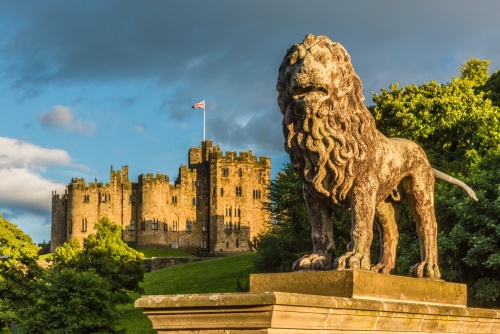
Although this entire overview could be devoted to the delights of the Northumberland countryside, to do so would do a disservice to the wonderful array of castles and early Christian remains. Northumberland's location made it a natural battleground between the Scots and English for centuries, and the number of fortified houses and castles attests to this turbulent past. Arguably the finest castle in the county, perhaps in the country, is Alnwick Castle, the seat of the powerful Percy family, Dukes of Northumberland, since 1309.
Alnwick has been called the "Windsor of the north", and it is hard to argue with that assessment of its importance. Alnwick's grim exterior hides the creature comforts within, for the castle was remodelled in Renaissance style, and boasts an interior replete with superb paintings, furniture, and a fine collection of porcelain. We can't mention the Percy's without taking note of their "other" fortress, Warkworth Castle, one of the finest fortified late medieval houses in England.
Near Alnwick is Chillingham Castle, which lays claim to the title of "the most haunted house in England", a moniker that may distract visitors from its bona fide historical position as an important 12th century Border fortress, and the romantic formal gardens and woodlands that surround it.
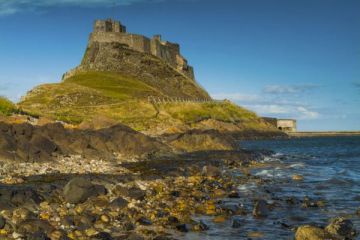
For sheer drama, it is hard to surpass Bamburgh Castle, perched upon a rocky headland. The Norman keep at the centre of the castle has been augmented by later classical additions, but the richly carved interior rooms are a treat for the medievalist and the casual visitor alike. From Bamburgh it is possible to view Holy Island, where the ruins of historic Lindisfarne Priory stand near a wonderfully evocative stately home built by Edward Lutyens from the foundations of a Tudor fort. For atmosphere, it is hard to top.

Holy Island, accessible at low tide via a causeway from the mainland, was once home to St. Cuthbert, whose followers fled with the saint's body from invading Danes and eventually founded Durham. The Lindisfarne Heritage Centre tells the tale of those dark times and has interactive displays allowing visitors to experience the making of the Lindisfarne Gospels, one of the most remarkable illuminated manuscripts in the world(now in the British Museum).
Across the south of the county stretches Hadrian's Wall, the remarkable 2nd-century barrier erected by the Romans to hold back the troublesome tribes of Scotland. Chesters Roman Fort, near Hexham, is the best surviving example of a Roman cavalry fort in Britain, and a museum displays artefacts found during excavation of the fort. Further forts can be visited at Rochester, Corbridge, Vindolanda, Housesteads, and there is a Roman Army Museum at Walltown, near Greenhead.
Early Christianity plays heavily in the story of Northumberland. It was here that the Celtic monks came to spread their religion to the pagan tribes of Britain, beginning as early as the 6th century. We've mentioned one of the finest historic Christian sites at Lindisfarne, but there are others worth noting.
Brinkburn Priory boasts an excellent early 12th-century church, and Hexham Abbey is a fine example of Early English style. At Woodhorn the parish church of St. Mary the Virgin contains an intriguing mix of Saxon, Norman, and Gothic architecture.
Note:
In an attempt to clear up possible confusion it is worth noting that Northumberland is a county, while "Northumbria" is an administrative district made up of four counties; Northumberland, Tyne & Wear, County Durham, and Tees Valley (formerly Cleveland).
More Photos