Historic London Churches
All Hallows London Wall - Holy Trinity, Sloane Street
An A-Z of historic or architecturally significant churches to visit in London. Note that most are relatively modern. This is due to the horrible destruction of the Great Fire in 1666, which burned some 100 churches in London. So most of the churches you can see today date from the late 17th or early 18th century.
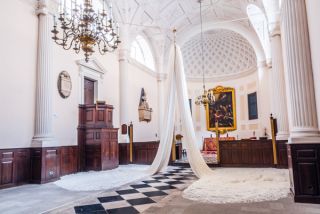
All Hallows London Wall is an 18th-century church built by George Dance the Younger. The churchyard is bounded by one of the few remaining sections of the original London Wall.
83 London Wall,
London,
Greater London,
England, EC2M 5ND
Heritage Rating: 
Nearest: Hotels - Self Catering - Bed
and Breakfasts
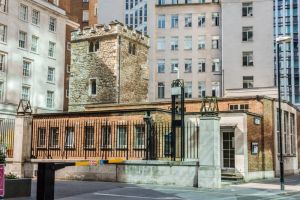
All Hallows Staining is a historic medieval church, beloved of Queen Elizabeth I. Little save the tower now remains from this early church, believed to be one of the first built in the City of London. Certainly, it was in existence in the 16th century, for Princess Elizabeth, later Elizabeth I, donated new bell ropes to the church. The princess said that the bells of All Hallows had been music to her ears during the time she spent incarcerated by her sister Mary in the Tower of London. One of those famous bells, dated to 1458, is preserved at Grocers Hall, London.
Mark Lane,
London,
Greater London,
England, EC3R 7AA
Heritage Rating: 
Nearest: Hotels - Self Catering - Bed
and Breakfasts
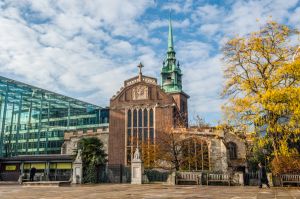
Samuel Pepys climbed the tower of All Hallows to look upon the destruction of the Great Fire. The church, which dates from the 12th-15th centuries, survived the flames but was badly damaged in the Blitz. Thankfully, the font cover, crafted by master woodcarver Grinling Gibbons, was untouched by the bombs. In the crypt there is evidence of Roman paving, and stones from the 7th-century Saxon church that stood here.
Byward Street,
London,
Greater London,
England, EC3R 5BJ
Heritage Rating:
Nearest: Hotels - Self Catering - Bed
and Breakfasts
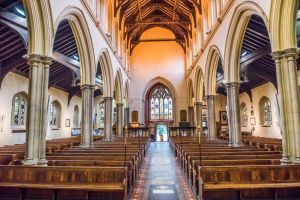
All Saints church dates to at least the 14th century, though most of the building we see today is Victorian, save for the medieval tower. All Saints is known for its superb collection of historic memorials, including 11 Bishops of London, who lived at neighbouring Fulham Palace.
Pryors Bank,
London,
Greater London,
England, SW6 3LA
Heritage Rating:
Heritage Highlight: Burial place of 11 Bishops of London
Nearest: Hotels - Self Catering - Bed
and Breakfasts
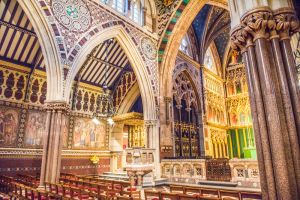
All Saints, Margaret Street is a masterpiece of Victorian Gothic style by one of Victorian England's most accomplished architects, William Butterfield. All Saints was begun in 1849 with money provided by AJ Beresford Hope, a wealthy businessman who shared Butterfield's enthusiasms for the newly popular Tractarian theology. Butterfield was a staunch Catholic with firm ideas about what constituted proper church architecture. In the All Saint's project he found a wonderful opportunity to express his religious principles allied with his natural flair for architecture.
7 Margaret Street,
London,
Greater London,
England, W1W 8JG
Heritage Rating:
Heritage Highlight: Superb Victorian church by William Butterfield
Nearest: Hotels - Self Catering - Bed
and Breakfasts
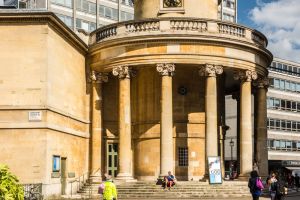
All Soul's Church Langham Place is a classical church designed by John Nash, built in 1822 as part of his vision for developing Regent Street. The church boasts a circular portico topped by a remarkable needle spire.
2 All Souls Place,
London,
Greater London,
England, W1B 3DA
Heritage Rating:
Nearest: Hotels - Self Catering - Bed
and Breakfasts
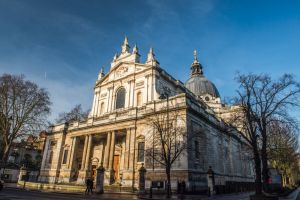
Brompton Oratory is an ornate (that's putting it mildly!) Italian Catholic church built in 1884. Within the Oratory is a magnificent organ containing nearly 4000 pipes. The church has the third widest nave in Britain after Westminster Abbey and York Minster. The true name of this extraordinary Roman Catholic church is the Oratory of St Philip Neri, but it is more commonly, though inaccurately, referred to as the Brompton Oratory. The church was begun in 1878 and the striking dome was finished by 1896 in flamboyant Baroque style.
The London Oratory, Brompton Road London,
Greater London,
England, SW7 2RP
Heritage Rating:
Nearest: Hotels - Self Catering - Bed
and Breakfasts
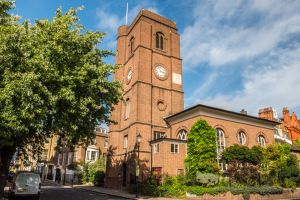
Standing just a few yards from the River Thames, this historic church has a history going back into the depths of the Dark Ages. There was almost certainly a church in this spot by the 8th century, and it served as the parish church for Chelsea before the area was absorbed into the growing London metropolis.
64 Cheyne Walk, London, Greater London, England, SW3 5LT
Heritage Rating:
Nearest: Hotels - Self Catering - Bed
and Breakfasts
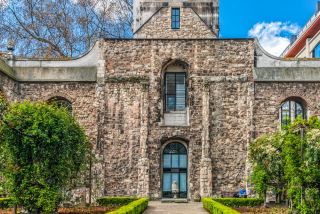
Christchurch Greyfriars began as a 13th-century Franciscan monastery. It was the burial place of four medieval queens including Isabella, wife of Edward II, whose ghost is said to haunt the site. The medieval church was destroyed in the Great Fire of London, rebuilt by Wren, then destroyed again in the Blitz. The church nave has been converted into a public garden.
King Edward Street,
London,
Greater London,
England, EC1A 7BA
Heritage Rating:
Heritage Highlight: Burial place of four medieval queens
Nearest: Hotels - Self Catering - Bed
and Breakfasts
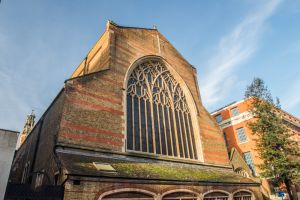
Holy Trinity, Sloane Street is a superb late 19th-century Arts and Crafts style church with excellent stained-glass windows executed by William Morris and Edward Burne-Jones.
Sloane Street,
London,
Greater London,
England, SW1X 9BZ
Heritage Rating:
Heritage Highlight: Arts and Crafts stained glass by William Morris and Edward Burne-Jones
Nearest: Hotels - Self Catering - Bed
and Breakfasts