The Victorian city of London was a city of startling contrasts. New building and affluent development went hand in hand with horribly overcrowded slums where people lived in the worst conditions imaginable. The population surged during the 19th century, from about 1 million in 1800 to over 6 million a century later. This growth far exceeded London's ability to look after the basic needs of its citizens.
A combination of coal-fired stoves and poor sanitation made the air heavy and foul-smelling. An immense amount of raw sewage was dumped straight into the River Thames. Even royals were not immune from the stench of London - when Queen Victoria occupied Buckingham Palace her apartments were ventilated through the common sewers, a fact that was not disclosed until some 40 years later.
Upon this scene entered an unlikely hero, an engineer named Joseph Bazalgette. Bazalgette was responsible for the building of over 2100 km of tunnels and pipes to divert sewage outside the city. This made a drastic impact on the death rate, and outbreaks of cholera dropped dramatically after Bazalgette's work was finished. For an encore, Bazalgette also was responsible for the design of the Embankment, and the Battersea, Hammersmith, and Albert Bridges.
Before the engineering triumphs of Bazalgette came the architectural triumphs of George IV's favourite designer, John Nash. Nash designed the broad avenues of Regent Street, Piccadilly Circus, Carlton House Terrace, and Oxford Circus, as well as the ongoing transformation of Buckingham House into a palace worthy of a monarch.
In 1829 Sir Robert Peel founded the Metropolitan Police to handle law and order in areas outside the City proper. These policemen became known as "Bobbies" after their founder.
Just behind Buckingham Palace, the Grosvenor family developed the aristocratic Belgrave Square. In 1830 land just east of the palace was cleared of the royal stables to create Trafalgar Square, and the new National Gallery sprang up there just two years later.
The early part of the 19th century was the golden age of steam. The first railway in London was built from London Bridge to Greenwich in 1836, and a great railway boom followed. Major stations were built at Euston (1837), Paddington (1838), Fenchurch Street (1841), Waterloo (1848), and King's Cross (1850).
In 1834 the Houses of Parliament at Westminster Palace burned down. They were gradually replaced by the triumphant mock-Gothic Houses of Parliament designed by Charles Barry and A.W. Pugin.
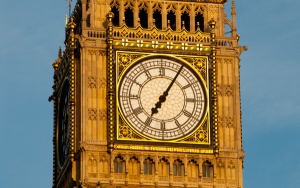
The clock tower of the Houses of Parliament, known erroneously as Big Ben, was built in 1859. The origin of the name Big Ben is in some dispute, but there is no argument that the moniker refers to the bells of the tower, NOT to the large clock itself.
In 1848 the great Potato Famine struck Ireland. What has this to do with the history of London? Plenty. Over 100,000 impoverished Irish fled their native land and settled in London, making at one time up to 20% of the total population of the city.
Prince Albert, consort of Queen Victoria was largely responsible for one of the defining moments of the era that bears his wife's name; the Great Exhibition of 1851. This was the first great world's fair, a showcase of technology and manufacturing from countries all over the world. The Exhibition was held in Hyde Park, and the centrepiece was Joseph Paxton's revolutionary iron and glass hall, dubbed the "Crystal Palace".
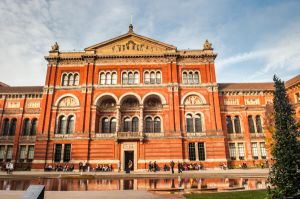
The exhibition was an immense success, with over 200,000 attendees. After the event, the Crystal Palace was moved to Sydenham, in South London, where it stayed until it burned to the ground in 1936. The proceeds from the Great Exhibition went towards the founding of two new permanent displays, which became the Science Museum and the Victoria and Albert Museum.
The year 1863 saw the completion of the very first underground railway in London, from Paddington to Farringdon Road. The project was so successful that other lines soon followed.
But the expansion of transport was not limited to dry land. As the hub of the British Empire, the Thames was clogged with ships from all over the world, and London had more shipyards than anyplace on the globe.
For all the economic expansion of the Industrial Revolution, living conditions among London's poor were appalling. Children as young as 5 were often set to work begging or sweeping chimneys. Campaigners like Charles Dickens did much to make the plight of the poor in London known to the literate classes with his novels, notably Oliver Twist. In 1870 those efforts bore some fruit with the passage of laws providing compulsory education for children between the ages of 5 and 12.
What to See:
Victoria Embankment
Regent Street
Piccadilly Circus
Trafalgar Square
National Gallery
Houses of Parliament
Victoria and Albert Museum
Science Museum
<< Back Georgian
Next >> 20th Century
London History
Roman | Anglo-Saxon | Medieval | Tudor | Stuart | Georgian | Victorian | 20th century London