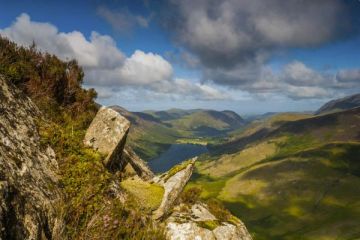
Derwentwater has been dubbed the 'Queen of the Lakes', and with good reason. There is everything here that makes a holiday in the Lake District such a treat. High and low level walks for any level of fitness, great viewpoints, fabulous scenery, water activities, heritage museums, and one of the finest prehistoric monuments in the UK for good measure!
Derwentwater (or Derwent Water, as it is sometimes spelled) is about 3 miles long and half that in width. The water is quite shallow given the size of the lake, only just reaching 70 feet.
It is perhaps fitting that much of the area around Derwentwater is owned by the National Trust, for it was here in 1902 that the Trust acquired its first property in the Lake District (Brandelhow Park, on the eastern shore of the lake). Author Beatrix Potter stayed here at Lingholm on the western shore.
There are four fair-sized islands on Derwentwater. The largest of these is Derwent Isle, which in the 15th century was home to German miners brought to the area to help mine copper in Newlands Valley to the west.
St Herbert's Isle is named for the 7th century monk, Herbert, a friend and contemporary of St Cuthbert, who had a friary here. Lord's Island, now owned by the National Trust, was once owned by the monks of Furness Abbey, in the south of Cumbria. Rampsholme Island is named for the wild garlic, or 'ramp' that once grew wild here.

Unlike some lakes in the park which are kept free from boats, Derwentwater encourages such marine activities. Boats can be rented from marinas at Keswick and Lingholm. Launch trips up and down the lake are available from Keswick.
Some of the most popular walks in the National Park can be found around Derwentwater. On the western shore, the ascent of Catbells is a massively popular low-level climb. The views from the summit of Catbells are superb, but if you want to come in summer, come early, as it can be crowded.
On the western shore, Surprise View, on the ascent to Watendlath Tarn, offers superb views up the lake. At the southern tip of the lake a steep but short walk to Castle Crag, one of the two 'Jaws of Borrowdale' also offers good views. Castle Crag can be easily combined with a longer walk past Grange to Manesty Wood, and on to the National Trust jetty at Hawesend.
The most popular visitor attraction in the area is Castlerigg stone circle. This prehistoric monument is located just outside Keswick. The circle is set in a stunning location, with open views to the fells around. The stones are not so impressive as those of Stonehenge, but the setting is unparalleled, and a visit for sunrise or sunset will be an unforgettable experience.
The town of Keswick is the only settlement of any real size in the area. Keswick is geared towards outdoor pursuits, with a number of shops supplying top quality footwear and other gear for enjoying walking, boating, and other outdoor activity in the Lake District.
Keswick is famous as a centre of pencil making, and though many of the pencil factories are gone there is an interesting museum detailing the history of the area and its industrial past.
About Derwentwater Lake
Address: Keswick,
Lake District,
Cumbria,
England
Attraction Type: Countryside - Lake
Location: Keswick, the centre for Derwentwater, is best accessed off the A66 (exit the M6 at Penrith).
Website: Derwentwater Lake
Location map
OS: NY 260200
Photo Credit: David Ross and Britain Express
HERITAGE
 We've 'tagged' this attraction information to help you find related historic attractions and learn more about major time periods mentioned.
Find other attractions tagged with:
stone circle (Historical Reference) -
NEARBY HISTORIC ATTRACTIONS
Heritage Rated from 1- 5 (low to exceptional) on historic interest
Lodore Falls Waterfall - 0.8 miles (Countryside) 
Derwent Island House - 1.8 miles (Historic Building)
Castlerigg - 2.1 miles (Prehistoric Site) 
Bowder Stone - 2.3 miles (Countryside) 
Keswick Museum - 2.4 miles (Museum)
Castle Crag - 2.6 miles (Countryside)
Crosthwaite, St Kentigern's Church - 2.7 miles (Historic Church) 
Force Crag Mine - 3.9 miles (Family Attraction)