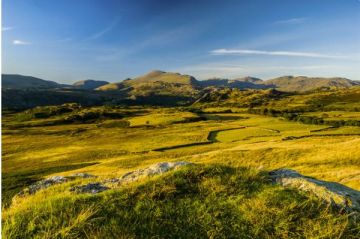
Roman sites in the Lake District

Remains of a 2nd-century Roman fort at the head of Lake Windermere. The fort was built during Emperor Hadrian's reign to guard the road from Ravenglass on the coast to Brougham, south of Penrith. The remains include the commandant's house and the granary foundations. Also known as Galava Roman Fort.
Ambleside, Lake District, Cumbria, England, LA22 0EN
Heritage Rating:  ?
?
Nearest Self Catering Cottages

Banks East Turret is the well-preserved remains of a turret used by Roman soldiers defending Hadrian's Wall. Short sections of the wall still stand on either side of the turret.
Pike Hill, Banks, Hadrian's Wall, Cumbria, England, CA8 2BX
Heritage Rating:  ?
?
Nearest Self Catering Cottages

One of the best Roman forts along Hadrian's Wall, set amid beautiful North Penines scenery.
Gilsland, Brampton, Hadrian's Wall, Cumbria, England, CA8 7DD
Heritage Rating: ?
Nearest Self Catering Cottages

The extensive remains of a Roman fort lie in an astonishing, remote position high above Eskdale on the western slopes of Hardknott Pass. Hardknott was established in the early 2nd century AD, and the foundations reveal a commandant's house, barracks, parade ground, and bathhouse. The location in an exposed position below the summit of Hardknott Pass is spectacular.
Hardknott Pass, Eskdale, Ravenglass, Lake District, Cumbria, England, CA19 1TH
Heritage Rating:  ?
?
Nearest Self Catering Cottages

Atop Hare Hill, just west of Banks village, is a short section of Hadrian's Wall, standing to a height of almost nine feet. The core of the wall is original but there has been some later refacing done on the exterior surfaces.
Hare Hill, Hadrian's Wall, Cumbria, England, CA8 2JJ
Heritage Rating: ?
Heritage Highlight: The most westerly significant section of Hadrian's Wall
Nearest Self Catering Cottages

Harrows Scar is a well-preserved Roman milecastle on Hadrian's Wall, on the western side of the River Irthing gorge. The milecastle is part of a well-preserved section of Hadrian's Wall, stretching for over a mile across the east Cumbrian hills. Harrows Scar is connected to Birdoswald Roman Fort, one of the most important Roman forts along the Wall.
Birdoswald, Hadrian's Wall, Cumbria, England, CA8 7DD
Heritage Rating: ?
Nearest Self Catering Cottages

Leahill and Piper Sike are a pair of turrets that formed part of the Hadrian's Wall defences. Both were built as part of the early phase of building on the Wall, around AD 122. The two turrets are within a short walk of each other on the minor road west of Birdoswald Roman Fort.
Wall Bowers, Banks, Hadrian's Wall, Cumbria, England, CA8 2BX
Heritage Rating: ?
Nearest Self Catering Cottages

Pike Hill Signal Tower is a Roman signal station dating to the early 2nd century, later incorporated into Hadrian's Wall. It stands at right angles to the line of the Wall, presumably to allow for easier signalling to other signal stations at Barrock Fell and Gillalees Beacon.
Banks, Hadrian's Wall, Cumbria, England, CA8 2BX
Heritage Rating: ?
Nearest Self Catering Cottages

Poltross Burn is one of the best-preserved milecastles along Hadrian's Wall. The interior is 21.5 metres by 18.5 metres in size, and within the milecastle are remains of an oven and a section of a stair leading up to the ramparts of the Wall.
Gilsland, Hadrian's Wall, Cumbria, England, CA8 7BJ
Heritage Rating: ?
Nearest Self Catering Cottages

On the edge of Ravenglass stand the remains of a Roman bathhouse associated with the fort of Glannaventa across the lane. Though there is little to see of the fort, plenty of the bathhouse remains to explore. The walls stand to over 12 feet in height, making the bathhouse one of the tallest surviving Roman sites in northern England.
Ravenglass, Cumbria, England, CA18 1SR
Heritage Rating: ?
Nearest Self Catering Cottages